Your Company, Your Articles, Your Experience
Send us your articles and get featured in the SKÅL International Newsletter for free

SUMMARY OF ARTICLES
This section contain authored articles with free copyright, just sent by our members.
1 HVAC Energy Saving
by Sk. Jatin Paul Singh, SKÅL Delhi.
How saving energy on Air Conditioning and heating, with CONTINEWM® Technology and a correct water management helped ITC Maurya won the Skal Sustainability Award 2025.
2 WATER IRRIGATION PUMPS Energy Saving
by Sk. Georges Koch, SKÅL Montreux Vevey.
How saving energy on Resorts irrigation systems is what you should do...now!
3 SHOWER HEATERS Energy Recovery from AC
by Sk. Claudio Cerquetti, SKÅL Koh Samui.
Recycle the hot water coming from your air conditioner cooling system to saving energy or rooms showers.
Why Energy Saving Should Start with HVAC Systems
Saving energy at the HVAC level produces benefits beyond lower electricity bills. It can extend equipment life, reduce maintenance,
improve temperature stability and lower the building’s carbon footprint.
by Sk. Jatin Paul Singh, SKÅL Delhi Club
In hotels, resorts, schools and shopping centres, heating, ventilation and air-conditioning systems are often among the biggest users of electricity. In tropical climates, where cooling may operate throughout the day and night, HVAC (both for cooling or heating) can represent the largest opportunity for reducing energy consumption.
For this reason, energy-saving programmes should begin by examining chillers, rooftop units, fan coils, air-handling units, ventilation systems and cooling towers.
Even a small improvement in heat exchange, airflow or compressor efficiency can generate substantial savings because the equipment operates for many hours daily.
The first step is to ensure that filters, coils and ducts are clean and that thermostats, sensors and controls are calibrated.
Variable-speed drives, zoning, intelligent scheduling and preventive maintenance can also reduce unnecessary operation.
Technologies such as CONTINEWM® can further improve HVAC efficiency by supporting better heat exchange at the cooling coil and reducing the workload of compressors and fans. Because the system requires no electrical power, it can be installed as a retrofit without replacing existing equipment, and save ing on top of what is saved by having implemented brand new equipments.
Saving energy at the HVAC level produces benefits beyond lower electricity bills. It can extend equipment life, reduce maintenance, improve temperature stability and lower the building’s carbon footprint.
Before investing only in new energy generation, it therefore makes sense to reduce the largest existing source of consumption first.

Reducing Electricity Consumption from Resort Irrigation Pumps
Variable-speed drives can allow the pump to slow down when full pressure is not required, saving electrical energy especially in dry seasons.
by Sk. Georges Koch, SKÅL Montreux Vevey Club
Resorts often use large quantities of water for gardens, lawns and landscaping. The electricity required to move this water can become a significant operating cost, especially when pumps run for long periods or work against unnecessary pressure.
The first opportunity is to match the pump to irrigation demand.
Oversized pumps consume more electricity than necessary and often create excess pressure that is later reduced by valves. Variable-speed drives can allow the pump to slow down when full pressure is not required, while irrigation zones can be scheduled separately according to size, soil and plant needs.
Drip irrigation, moisture sensors, weather-based controls and night-time watering can reduce water use and pumping time. Leaks, blocked filters, damaged sprinklers and poorly designed pipework should also be corrected, because every unnecessary litre must still be pumped.
Where land, structure and local regulations permit, a tall water tank can provide additional savings. Water can be pumped into the tank during selected periods, then distributed partly by gravity.
This may reduce continuous pumping and provide useful emergency storage. However, tank height, structural cost and pressure requirements must be professionally calculated.
A complete irrigation strategy should combine efficient pumps, intelligent controls, suitable plants and good water management. Saving electricity and saving water should be treated as the same operational objective.

Using Air-Conditioning Waste Heat for Showers and Bathtubs
Recovering condenser heat turns an unavoidable by-product of air conditioning into a useful energy source, reducing operating costs and environmental impact.
by Sk. Claudio Cerquetti, SKÅL Koh Samui
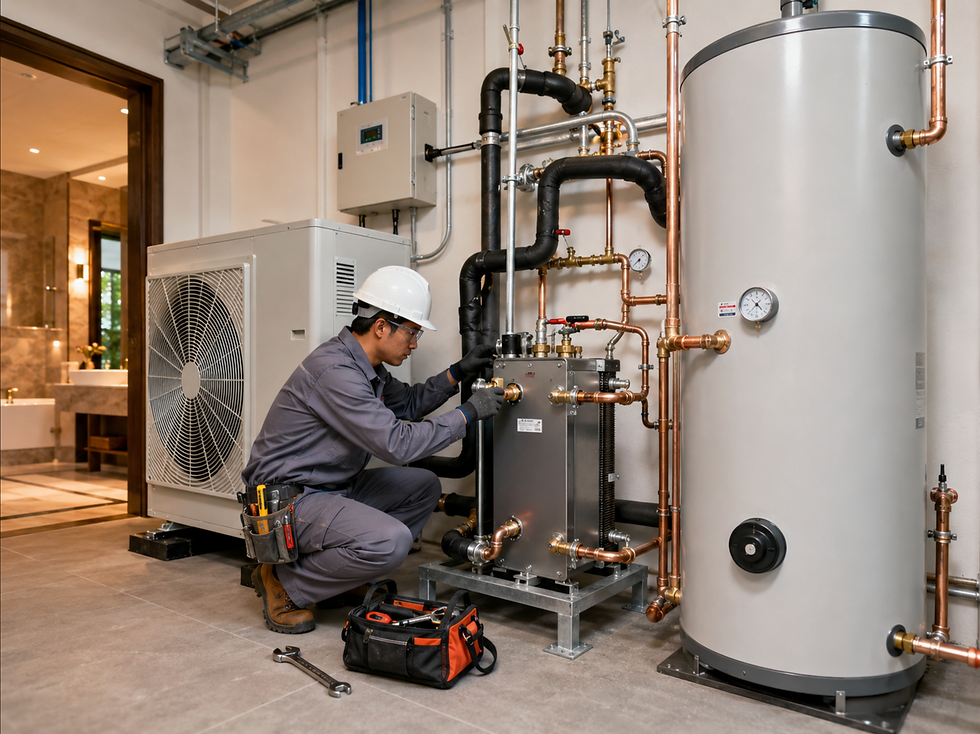
Every air-conditioning system removes heat from indoor spaces and releases it outdoors through its condenser. In most buildings, this thermal energy is discharged into the atmosphere. Hotels and resorts can recover it and use it to preheat water for showers, bathtubs, kitchens, laundries or swimming pools.
The usual solution is not a radiator placed directly inside the shower-water tank. Instead, a suitable heat exchanger transfers heat safely from the air-conditioning or refrigeration circuit to a separate water circuit. This equipment may be called a heat-recovery unit, desuperheater or refrigerant-to-water heat exchanger.
Recovered heat can preheat incoming cold water before it enters the main boiler, electric heater or heat-pump water heater. The conventional system then needs less electricity or fuel to reach the required temperature.
Large central chiller plants can also use heat-recovery chillers that produce cooling and hot water simultaneously.
For safety, potable water must remain separated from refrigerant and technical fluids, and the system must include temperature controls, pressure protection, storage tanks and anti-Legionella procedures. A qualified mechanical engineer should design the installation.
This approach is especially attractive for resorts because cooling demand and hot-water demand often occur simultaneously.
Re-thinking Solar Panels
Recovering condenser heat turns an unavoidable by-product of air conditioning into a useful energy source, reducing operating costs and environmental impact.
by Mark Cloudy, Samui.Green.
Every air-conditioning system removes heat from indoor spaces and releases it outdoors through its condenser. In most buildings, this thermal energy is discharged into the atmosphere. Hotels and resorts can recover it and use it to preheat water for showers, bathtubs, kitchens, laundries or swimming pools.
The usual solution is not a radiator placed directly inside the shower-water tank. Instead, a suitable heat exchanger transfers heat safely from the air-conditioning or refrigeration circuit to a separate water circuit. This equipment may be called a heat-recovery unit, desuperheater or refrigerant-to-water heat exchanger.
Recovered heat can preheat incoming cold water before it enters the main boiler, electric heater or heat-pump water heater. The conventional system then needs less electricity or fuel to reach the required temperature.
Large central chiller plants can also use heat-recovery chillers that produce cooling and hot water simultaneously.
For safety, potable water must remain separated from refrigerant and technical fluids, and the system must include temperature controls, pressure protection, storage tanks and anti-Legionella procedures. A qualified mechanical engineer should design the installation.
This approach is especially attractive for resorts because cooling demand and hot-water demand often occur simultaneously.

Re-thinking Solar Panels
Why we should Save Energy Before Investing More Money in Producing More Energy
by Mark Cloudy, Samui.Green.
Solar panels can support the energy transition, but they should not be the first response to excessive consumption. Photovoltaic panels are not a new innovation: commercial solar technology has existed for many decades. Although it has improved, its fundamental limitations remain.
Solar systems require, extensive roof or land area, structural assessments, safe installation, inverters, cabling and, when storage is needed, costly batteries that eventually require replacement and of course high initial investment with a ROI between 5 and 7 years! Energy output depends on sunlight, weather, season, heat, shade and cleanliness, and panels produce nothing at night.
Limited space may mean that they cover only a small proportion of a property’s total electricity demand. Dust, humidity, salt and corrosion can reduce performance and increase cleaning and maintenance requirements.
Panels gradually degrade, repairs require specialised technicians, and the financial return can take years. Manufacturing consumes energy and raw materials, while mining, transportation, damaged components and end-of-life recycling or disposal possibilities (totally absent in many countries) create additional environmental impacts.
Most importantly, solar panels do not correct energy waste. In hotels and many commercial buildings, HVAC can represent around 60% of electricity consumption. Producing additional electricity to compensate for inefficient air-conditioning is like filling a leaking tank without repairing the leak.
The logical order is simple: measure consumption, eliminate waste and improve efficiency first. Renewable generation should then supply only the remaining, genuinely necessary demand. The cleanest and cheapest energy is the energy we never need to produce.

The Swimming Pool That Does Not Run at Full Speed
Why we should Save Energy Before Investing More Money in Producing More Energy
by Nam Toking, ElectTech Co.Ltd.
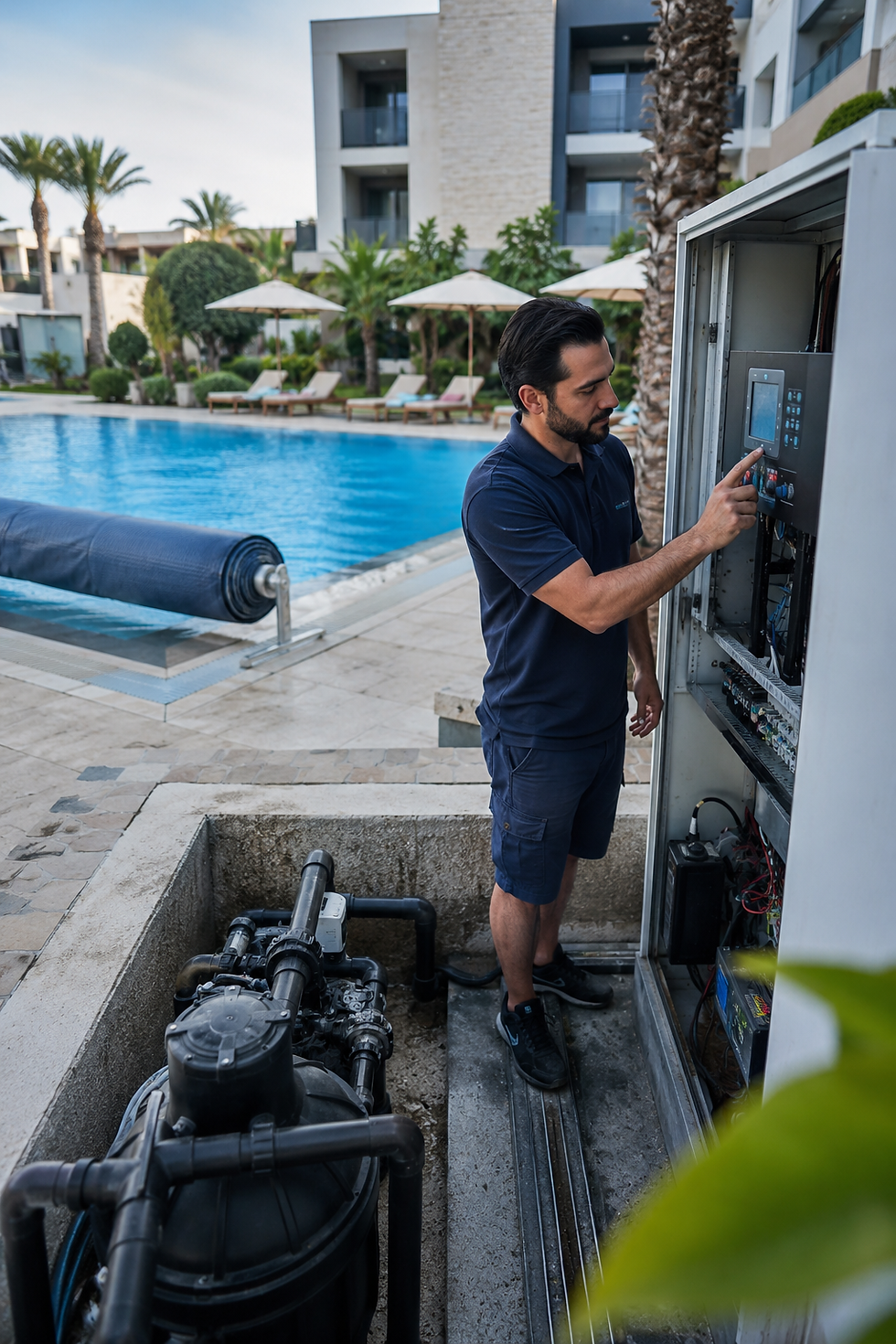
A swimming pool can continue consuming large amounts of energy even when very few people are using it. Pumps may operate continuously at maximum speed, heated water constantly loses heat from the surface, and filters may be cleaned according to a fixed routine whether they need it or not.
A more efficient approach is to make the pool respond to what is actually happening.
One of the most useful technologies is the variable-speed pump. A traditional pump may operate at one fixed speed whenever it is switched on. A variable-speed pump can instead operate faster or slower according to the amount of water circulation actually required.
During busy periods, the system can increase circulation. During quieter periods, when less circulation is necessary, the pump can slow down and consume less electricity.
Water-quality sensors can also help. These are devices that continuously monitor important conditions in the pool water and help the treatment system provide the correct amount of chemicals rather than relying only on fixed schedules.
Pool covers offer another simple opportunity. When correctly used, they reduce evaporation and help prevent heat from escaping from the surface of a heated pool.
European Commission tourism guidance estimates that good management and basic improvements, including variable-speed pumps and heat exchangers, could save approximately €50,000 to €85,000 per year for a 25-metre pool in the example considered. The same guidance gives an estimated payback period of one to three years for pool covers.
Of course, results depend on climate, electricity prices, pool size and operating hours. In very hot climates, for example, a cover may sometimes retain heat that the pool does not need.
Managers should therefore monitor pool pumps and heating separately, understand when the pool is busiest and review filtration schedules with a qualified specialist: the objective is not to reduce hygiene or guest comfort. It is simply to stop operating everything at maximum level when maximum operation is unnecessary.
A smart swimming pool works as hard as it needs to — and no harder.
.png)
The Energy Disappearing Down the Drain
Recovering Heat from Hotel Wastewater
by Akhesh Singh, Jammu Tech.
Every day, hotels send a surprising amount of valuable energy straight down the drain. Think about a hot shower, a spa treatment, a washing machine or a commercial laundry. We pay to heat that water, use it for a relatively short time, and then discharge it while it is still warm.
Wastewater heat recovery is a way of capturing some of that heat before the used water leaves the building. It does not mean reusing dirty water. Instead, the warm wastewater passes through a device called a heat exchanger, while fresh cold water passes separately through another part of the same device. The two water streams never touch or mix. Only the heat moves from one side to the other.
This means that the incoming fresh water arrives already slightly warmer and therefore requires less energy to bring it to the temperature needed for the next shower, laundry cycle or other use.
This solution is especially interesting for properties that use large and fairly predictable quantities of hot water, such as city hotels, ski resorts, wellness hotels, spas, commercial laundries and large kitchens.
There are different ways to install the technology. A vertical heat exchanger, for example, is normally installed around or alongside a vertical wastewater pipe, such as the pipe carrying water down from several showers. Larger central plant-room systems collect heat from several wastewater sources and recover it in one central location where the property's main mechanical equipment is installed. Horizontal systems are also available.
The United Kingdom's Energy Technology List recognises horizontal, vertical and central plant-room arrangements, showing that wastewater heat recovery is an established energy-efficiency technology rather than an experimental idea.
Good planning is important. Flow, water temperature and cleaning access all need to be considered, and installation may be particularly convenient during bathroom, spa or laundry renovation.
The basic idea, however, is very simple: before sending warm water away, recover some of the energy that you have already paid for.
.png)
Cold Water, Clean Linen
The Hotel Laundry Revolution
by Annie Brown, Timber Press.
For decades, hotel laundries have followed a familiar formula: plenty of hot water, long washing cycles and relatively large quantities of detergent and other chemicals. Today, new technologies are making it possible to obtain excellent washing results while using much less hot water.
One interesting solution is ozone laundry technology. Ozone is a form of oxygen that can be produced by a small generator and mixed, or dissolved, into the washing water. Once in the water, it helps the washing process remove certain soils and contaminants, allowing some laundry programmes to operate effectively at lower temperatures.
Modern detergents designed specifically for cooler washing can contribute as well. Some systems also recover relatively clean rinse water so that it can be reused during another suitable part of the laundry process.
Another useful development is programmable control. Instead of every load automatically receiving the same amount of water, chemicals and washing time, the machine can use different programmes according to what is being washed. Towels, sheets and restaurant linen, for example, may require different treatments.
The potential savings can be substantial. In a US Department of Energy demonstration involving retrofitted multi-load commercial washing machines, hot-water energy consumption was reduced by 63%. However, water consumption and electricity used by the ozone generator increased. This is an important reminder that the complete system must be evaluated, rather than looking at only one energy meter.
Hotels should therefore monitor water, electricity, fuel, chemicals, rewashing and the life of their linen.
A sensible approach is to begin with a controlled trial using normal hotel towels, sheets and food-and-beverage linen. Hygiene and cleanliness must remain the priority.
The real change is not simply about washing with cold water. It is about moving away from one standard, energy-intensive washing routine and instead using the right combination of temperature, time, water and chemicals for each type of laundry.
Evidence source: US Department of Energy Better Buildings – Multi-load Commercial Washer Technology Demonstration.

A Smarter Kitchen Uses Less Energy, Not Less Service
Why we Should Save Energy Before "Shrinking" Services
by Aziz Azamelek, Peace Hub
A hotel or restaurant kitchen can waste a considerable amount of energy before the first guest even orders a meal: ovens, fryers and grills are often switched on much earlier than necessary. Large appliances may stay hot during long quiet periods, and sometimes several machines remain running even though one properly selected appliance could perform the work.
Saving energy in the kitchen therefore does not mean reducing the menu or making guests wait longer. It means organising the kitchen so that equipment operates when it is actually needed.
One useful example is the induction hob. Instead of first heating a burner and then transferring that heat to the pan, induction creates heat directly in compatible cookware. It reacts very quickly when the chef changes the setting, making it easier to control cooking and avoid unnecessary heat.
Modern combination ovens can also perform several different cooking functions in one machine, while programmable cooking cycles help chefs reproduce the same result without repeatedly adjusting temperature and timing.
Efficiency during periods when equipment is waiting to be used is equally important. ENERGY STAR reports that certified gas and electric convection ovens are, on average, approximately 27% more energy-efficient than standard models. Their assessment includes both cooking efficiency and the amount of energy consumed while the oven is simply maintaining temperature.
An appropriately sized appliance simply means choosing equipment that matches the real needs of the kitchen. A very large oven continuously heated to prepare small quantities of food can waste energy: a clear operating schedule means deciding when each appliance actually needs to be preheated, used, reduced in temperature or switched off instead of automatically leaving everything running throughout the working day.
Kitchens can also save energy by using correctly sized pans, keeping lids on when appropriate, grouping production where food-safety requirements allow, and switching off unused cooking zones between services.
When buying equipment, hotels should consider not only the purchase price but also the electricity, gas and water that the appliance will consume during many years of operation.
The aim is simple: serve exactly the same food and provide exactly the same service, while stopping the kitchen from spending money heating equipment that is not actually doing anything.
.png)
Lighting That Thinks Before It Shines
Why we should Save Energy Before Investing More Money in Producing More Energy
by Silvana Ambergift, GreenColor Zone Ltd.
Replacing traditional lamps with LED lighting is already an important energy-saving measure. But there is another simple question worth asking: why should an empty room be fully illuminated?
Hotels, airports, shopping centres and conference facilities often operate for very long hours. Corridors, meeting rooms, offices, storage areas, car parks and back-of-house spaces may remain brightly illuminated even when nobody is there: modern lighting controls allow the building to react automatically.
Occupancy sensors detect whether people are present. Daylight sensors recognise when natural daylight entering through windows is sufficient and reduce artificial lighting accordingly. Other controls can establish a sensible maximum brightness for a particular space.
Schedules can also divide a building into different lighting zones instead of treating the entire property as one large area. For example, the reception may require full lighting throughout the night, while meeting rooms, offices, restaurants, storage areas and staff facilities may have completely different operating hours. Each area can therefore follow its own schedule.
The US Department of Energy has reported average lighting-energy savings of 49% across 194 networked lighting-control projects in commercial and industrial buildings. This percentage refers specifically to lighting consumption, not to the entire electricity bill of the building, but it clearly shows how much energy can be wasted through unnecessary lighting hours and excessive brightness.
The guest experience must, however, remain important. Hotel corridors should never become uncomfortable or feel unsafe because lights have been reduced too aggressively. Sensors also need to be positioned correctly so that somebody sitting quietly in a room is not suddenly left in darkness.
A good starting point is simply to walk around the property after normal operating hours and observe which lights are still on unnecessarily. Back-of-house areas, offices, meeting rooms, parking and storage areas are often easy places to begin.
Gradual dimming, sensible time delays and manual controls can make the technology almost invisible to guests: the objective is not darkness. It is providing exactly the amount of light people need, in the places where they need it, at the time they need it.
.png)
When the Lift Gives Energy Back
Regenerative Elevators in High-Rise Tourism
by Renato Dilo, Nikola Top
Lifts are essential in high-rise hotels, airports and observation towers, but every journey requires energy. Interestingly, during certain movements a lift can actually produce energy as well: in fact, in a conventional lift system, much of the energy created during braking is simply converted into heat and released.
A regenerative lift, or more precisely a lift fitted with a regenerative drive, can recover part of that energy.
Imagine a heavily loaded lift travelling downward. Gravity is helping to move the car, so the motor does not always need to consume electricity in the normal way. Under these conditions, the motor can act somewhat like a generator. A similar situation can occur when a lightly loaded lift travels upward while the counterweight moves downward.
Instead of turning the resulting energy into unwanted heat, a regenerative system can send useful electricity back into the building's electrical network.
Singapore's Housing & Development Board states that its Elevator Energy Regeneration System converts energy generated during lift movement and braking and can save up to 20% of lift energy consumption.
Additional savings may come from sleep modes. When a lift has not been called for some time, lights, displays or ventilation fans can sometimes automatically reduce continuous operation.
The potential benefit will be different in every building. This is what engineers mean when they talk about the business case: whether the cost of installing or upgrading the system is justified by the money and energy it is expected to save over time.
Factors such as the number of lift journeys, building height, passenger loads, the existing motor and the control system all influence the result: for this reason, operators should ideally record energy consumption and lift journeys over representative weeks before deciding whether regeneration should be included during a planned modernisation.
The lift does exactly the same job for the guest. The difference is behind the scenes: some of the energy normally lost during braking is captured and put back to useful work instead of being thrown away as heat.
.png)
Smarter Snow, Smaller Bills
How Technology Is Transforming Mountain Resorts
by James Ydlen, White Mountains Ltd.
Artificial snow is extremely important for many mountain resorts, but producing it requires considerable resources. Large amounts of water must be moved around the mountain, pumps and compressors consume electricity, and snow often has to be produced within relatively short periods when weather conditions are suitable.
For this reason, one of the best ways to save energy is simply not to produce snow where additional snow is unnecessary.
Modern automated snow guns help achieve this. A snow gun is the equipment positioned along a ski run that turns water — and, in some systems, compressed air — into artificial snow. Automated versions can respond to changing weather information instead of requiring staff to adjust each machine manually.
Temperature and humidity sensors tell the system whether conditions are suitable for efficient snowmaking. Central controls can then increase, decrease or stop production according to what each part of the mountain actually needs.
Another increasingly useful tool is LiDAR snow-depth mapping. LiDAR uses laser measurements to understand the shape and distance of surfaces. When the equipment is fitted to a grooming machine, it can compare the existing snow surface with the actual ground underneath: this allows the resort to see exactly where snow is already deep enough and where additional coverage is required.
Deer Valley LTD. has reported that its system saves water, electricity, compressed air and labour because snow can be produced specifically where it is needed. The resort also added 1,205 high-efficiency snow guns for the 2025–26 season.
This does not mean artificial snow has no environmental impact. Water availability must still be carefully considered.
Pumping impacts include the electricity required to move large volumes of water from reservoirs or other sources uphill and across the resort, as well as the consequences of withdrawing and storing that water.
Noise, wildlife, habitat disturbance and increasingly warm winters are also important considerations.
Smart snowmaking is therefore not about covering every possible slope. It is about knowing where snow is genuinely required, how much is required and when conditions allow it to be produced most efficiently.
The smartest snow may sometimes be the snow that the resort discovers it does not need to make.
.png)
The Hidden Cost Beneath the Waterline:
How Cruise Ships Can Reduce Drag and Fuel Use
by Saichon Jha, AmazingExperiences Co.Sg.
A cruise ship may look perfectly clean and efficient above the water, while an important source of energy loss remains almost invisible below the surface.
As a ship moves through the sea, water rubbing against the hull creates resistance, or drag. The greater the resistance, the harder the engines must work to maintain the required speed — and the more fuel they consume.
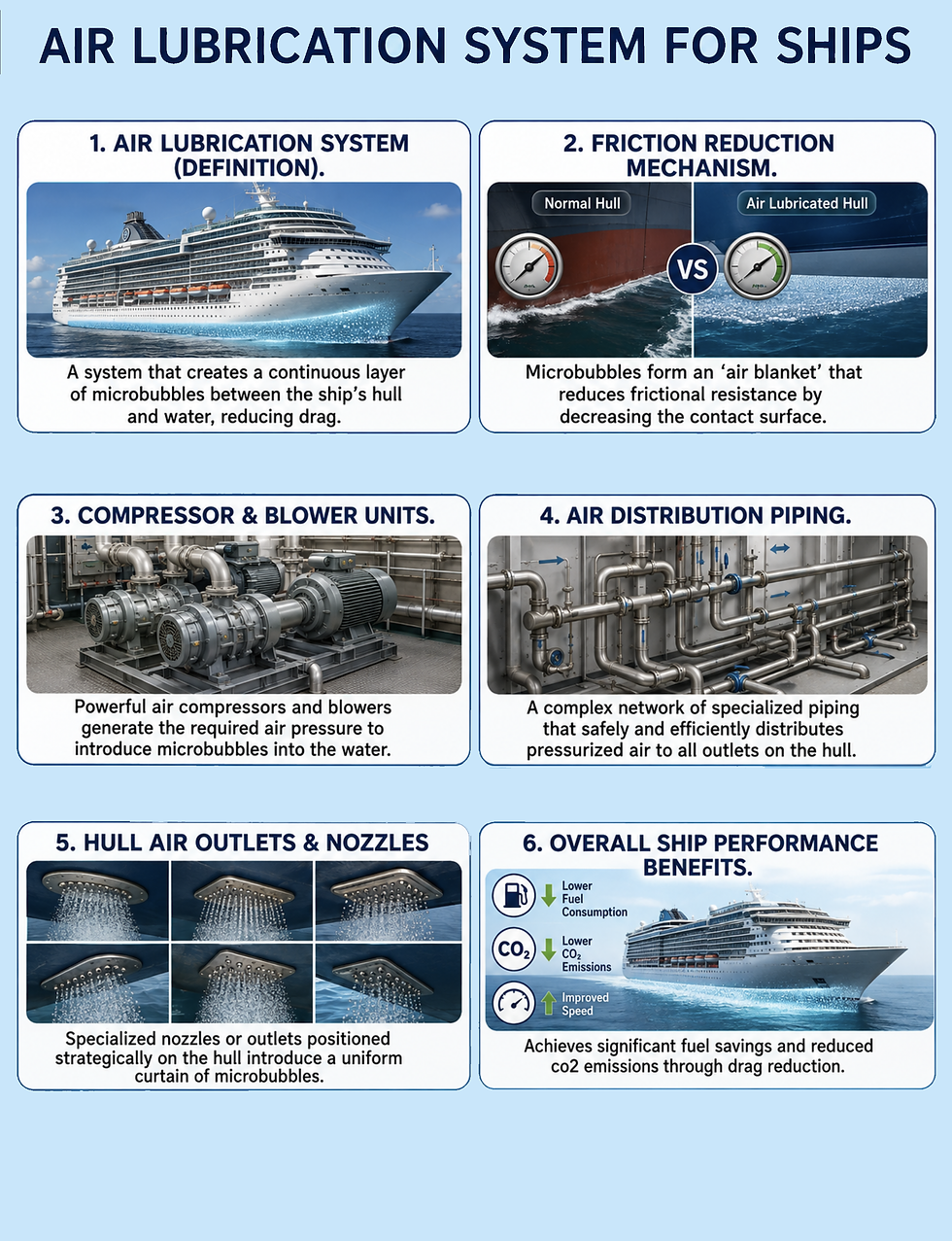
One technology designed to reduce this resistance is air lubrication.
The system releases air underneath part of the ship's hull, creating bubbles, an air layer or an air-filled area between part of the hull and the surrounding water. This reduces some of the friction between the ship and the sea.
With less resistance, less engine power may be required to maintain the same speed.
The International Maritime Organization's GreenVoyage2050 portal describes air-lubrication technology as well tested and commercially available for both new vessels and retrofit projects, including cruise ships and ferries. Full-scale installations indicate approximate net annual energy savings of 2–8%: the word net is important because producing the air also requires energy. Compressors must generate and move the air beneath the vessel. Therefore, the electricity used by the system has to be deducted when calculating the real saving.
Performance also depends on factors such as hull design, speed, sea conditions and how deeply the ship sits in the water.
Air lubrication should therefore be part of a broader hull-efficiency programme — in other words, several complementary actions aimed at helping the ship move through the water with as little resistance as reasonably possible.
These can include special low-friction hull coatings, regular hull inspections, responsible cleaning, propeller polishing and adjusting the ship's trim so that it travels efficiently through the water.
Cleaning must also be responsibly managed to avoid spreading invasive marine organisms or releasing unsuitable residues.
Before investing, cruise operators should first understand their normal fuel consumption and evaluate the routes on which the vessel actually operates.
For a cruise ship, energy efficiency is not only about what passengers can see. Some of the most important savings can begin beneath the waterline.
You Cannot Save What You Cannot See
Submetering and Energy Analytics for Tourism
Prof. Mark Reinmann, University of Tokyo
Every month, a hotel may receive an electricity bill showing exactly how much energy the property has consumed. But that bill usually does not answer the most important question:
Where did all that energy go? Was it used by the kitchen? The laundry? The swimming pool? Refrigeration? Lighting? Guest rooms? Offices? Or equipment that continued running all night when nobody needed it? This is where submetering becomes useful.
The main electricity meter measures the consumption of the whole property. Submeters are additional smaller meters installed to measure particular parts of the building or individual systems.
A hotel might therefore have one meter for the kitchen, another for the laundry, another for the pool and others for different buildings or guest-room floors.
When these meters record consumption at regular intervals, energy-management software can show managers exactly when energy is being used. This makes unusual peaks, unnecessary overnight consumption and equipment left running easier to identify.
More advanced fault-detection software goes a step further. It compares how equipment is operating with how it would normally be expected to operate and alerts the team when something appears unusual.
In the US Department of Energy's Smart Energy Analytics Campaign, participants achieved median whole-building savings of 4% using energy-information systems and 9% using fault detection and diagnostics after two years. Initial analysis indicated simple payback periods of approximately one to two years. The Department also notes that some savings may have resulted from other projects, meaning that analytics itself does not magically save energy — it helps people discover where action should be taken.
Hotels should therefore begin with practical questions rather than complicated screens.
Which systems continue consuming electricity overnight? Which laundry or kitchen consumes unusually high amounts? Why did consumption suddenly increase this week?
A modest dashboard reviewed weekly simply means having one clear screen showing the most useful energy information and assigning somebody to check it regularly — perhaps once every week — rather than investing in a complicated system filled with information nobody actually uses.
When an unusual number appears, somebody must investigate it, correct the cause and then check that consumption returns to normal.
Because when it comes to energy management, seeing the problem is often the first step toward solving it.
.png)